Description
What Olivia Ultra is
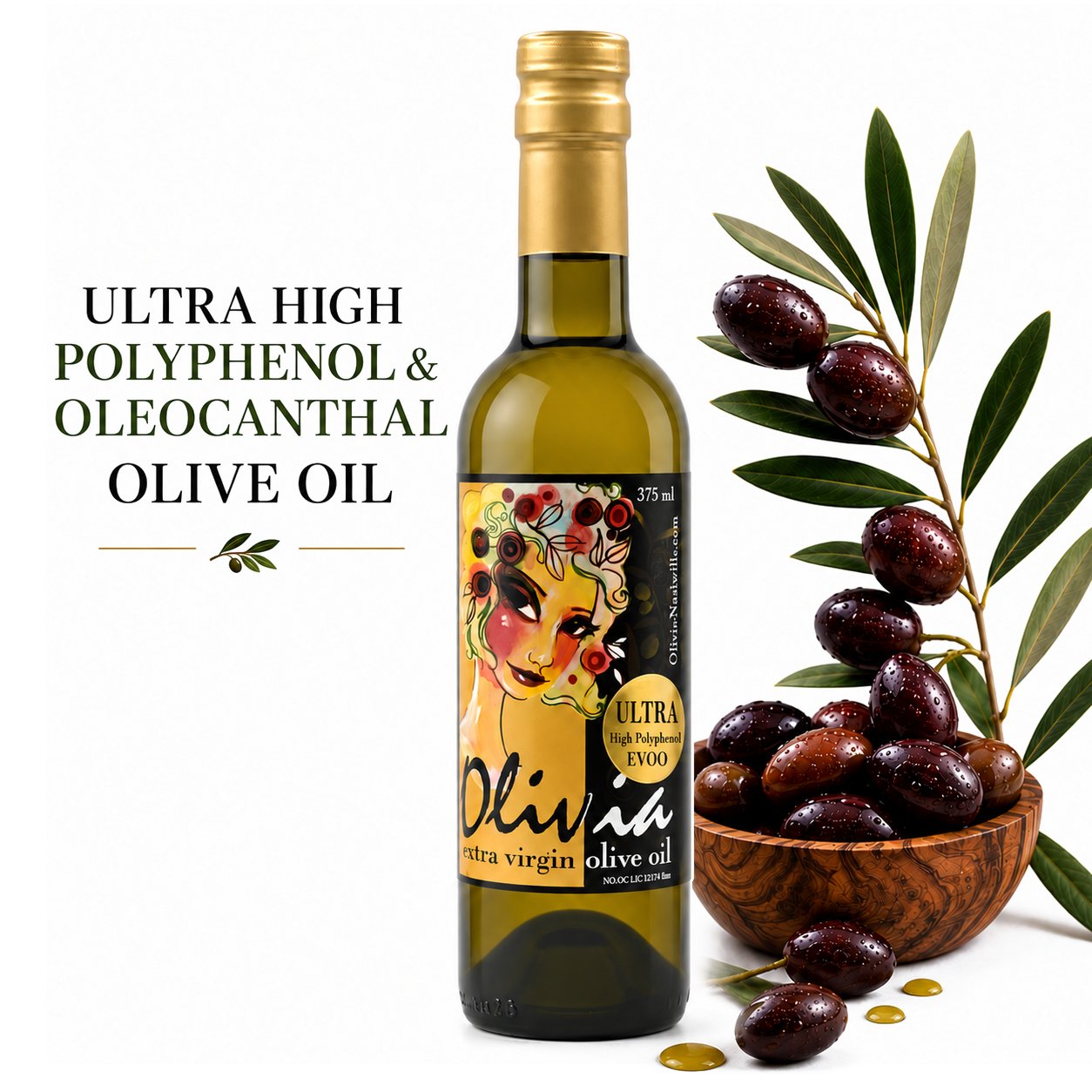
Olivia Ultra is a single-variety extra virgin olive oil pressed from early-harvested Kalamata olives in Greece and cold extracted within hours of picking. Almost every high-phenolic Greek oil you will find is Koroneiki. This one is not — and it tastes like it.
It is the oil we are pouring at the tasting bar while we wait for the next harvest, and it is the one we now hand to customers who ask which oil is highest in oleocanthal.
Looking for ZOI? It is between harvests until the new crop lands. Olivia Ultra is the oil we also offer to customers requiring super high polyphenol olive oil.
The numbers
| Measure | Olivia Ultra | What it means |
|---|---|---|
| Total polyphenols | 1,307 mg/kg (NMR) | Over 5× the 250 mg/kg level behind Europe’s approved health claim |
| Oleocanthal | 1,030 mg/kg (NMR) | The peppery compound researchers study most |
| Oleacein | 153 mg/kg (NMR) | Oleocanthal’s close relative, and usually the scarcer of the two |
| Oleocanthal + oleacein (D1) | 1,183 mg/kg | The combined index used in the published method |
| Free acidity | 0.20% | Extra virgin allows up to 0.8%; this is a quarter of the limit |
| Harvest | October 2025 | Analysed days after milling — the number is the harvest’s own |
| Variety | Kalamata, single variety | Unusual for a high-phenolic oil, and the reason it tastes different |
| Origin | Greece |
Figures are from an independent laboratory analysis of this harvest, performed by nuclear magnetic resonance at the National and Kapodistrian University of Athens. We quote the method because it matters: the same sample measured by HPLC returns a lower oleocanthal figure, and a number without a method behind it is not a number.
What the numbers actually mean
A typical supermarket extra virgin olive oil tests somewhere between 100 and 250 mg/kg of total polyphenols. A good early-harvest oil reaches 400 to 600. Olivia Ultra is at 1,307.
Two comparisons are worth more than any superlative, because you can check them both.
Against the European standard. The European Food Safety Authority has approved one claim for olive oil polyphenols: that they contribute to the protection of blood lipids from oxidative stress. EU Regulation 432/2012 sets the bar at 5 mg of hydroxytyrosol and its derivatives per 20 g of oil. Twenty grams of Olivia Ultra provides 26.14 mg — more than five times the threshold.
Against the research baseline. In the international survey of olive oils carried out at the University of California, Davis, the average sample measured 135 mg/kg of oleocanthal and 105 mg/kg of oleacein. Olivia Ultra measures 1,030 and 153.
The United States takes a narrower line than Europe, and it is worth quoting exactly. The FDA permits this qualified claim for high-oleic oils: “Supportive but not conclusive scientific evidence suggests that daily consumption of about 1½ tablespoons (20 grams) of oils containing high levels of oleic acid, when replaced for fats and oils higher in saturated fat, may reduce the risk of coronary heart disease.”
How it tastes
Assertively. An independent sensory panel scored it robust on fruitiness (5.0–7.0), strong on bitterness (4.0–6.0) and robust on pungency (5.0–7.0) — the upper end of the scale on all three.
On the nose it is deep and resinous, with olive leaf, arugula and wild herbs. In the mouth it is green and bitter through the middle and finishes with a pepper that catches at the back of the throat and will very likely make you cough the first time. That cough is the oleocanthal. It is the fastest way to tell a genuinely high-phenolic oil from an ordinary one.
If you have been drinking ZOI, expect something recognisably in the same family but greener and more herbal — the Kalamata fruit rather than the Koroneiki.
How to use it
Raw. Most customers take one to three teaspoons a day, straight, in the morning or with a meal. It is superb finishing grilled meat and roasted vegetables, and over lentils, white beans and bitter greens.
Do not cook with it. Heat spends the polyphenols you are paying for. Keep a good everyday extra virgin for the pan and save this for the finish.
Freshness and storage
Polyphenols fall faster in heat and light. This is the October 2025 harvest and it is best used within twenty-four months of it. Keep it in a dark cupboard with the cap on, not on the windowsill and away from heat.
Taste it first
Olivia Ultra is open on the tasting bar at 118 East Main Street in downtown Franklin. If you have never tried a truly high-phenolic oil, feel free to taste it before you buy.
Questions we get asked
How does Olivia Ultra compare to ZOI?
They are in the same tier, from different olives. ZOI is Koroneiki and tests at 1,397 mg/kg total polyphenols; Ultra is Kalamata at 1,307 mg/kg with 1,030 mg/kg oleocanthal. Ultra is greener and more herbal, ZOI rounder. ZOI is between harvests at the moment; Ultra is the current crop.
What counts as a high polyphenol olive oil?
There is no legal definition. The benchmark most labs and producers use is the European health-claim threshold of 250 mg/kg. Oils from 250 to 500 mg/kg are generally called high phenolic, above 500 very high, and above 1,000 ultra high. Olivia Ultra is 1,307.
Why does the measurement method matter?
Because different methods give different answers on the same oil. Measured by NMR, this harvest returns 1,030 mg/kg of oleocanthal; measured by HPLC, the figure is lower. Reputable sellers say which method they used. If a bottle quotes a number and will not tell you how it was measured, treat the number carefully.
Why does the harvest date matter more than a best-by date?
Polyphenols and flavour both decline from the day of milling, so a tested figure is only true for the harvest it was measured on. A best-by date is set by the bottler and says nothing about when the olives were picked. Olivia Ultra is the October 2025 harvest and the best by date is on the bottle.
How much should I take?
Most customers take one to three teaspoons a day. The FDA’s qualified claim is based on about 1½ tablespoons of high-oleic oil a day replacing saturated fat. More is not necessarily better — olive oil is about 120 calories a tablespoon.
Can I cook with it?
You can, but we would not. Heat degrades the polyphenols that make this oil what it is. Use it raw and keep an everyday extra virgin for cooking.